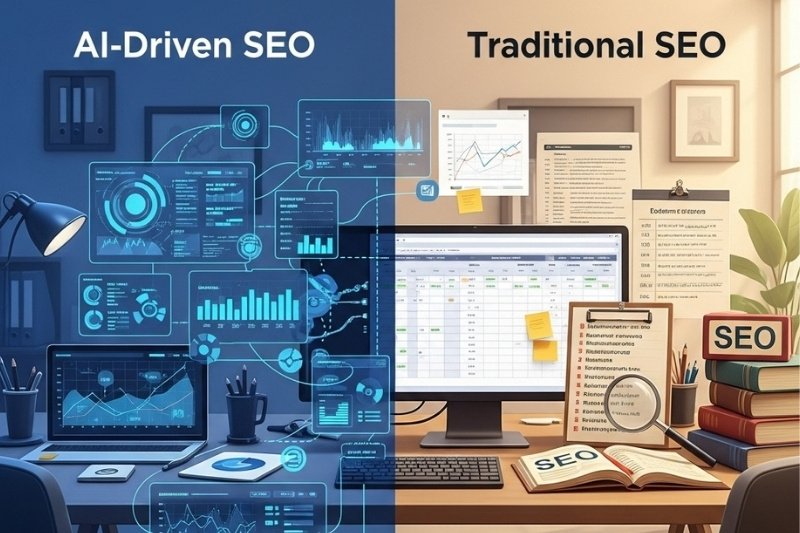

- Predictive SEO uses AI to forecast ranking and traffic changes before they happen
- It shifts SEO from reactive fixes to proactive, data-led planning
- AI models identify rising keywords, emerging opportunities, and potential risks
- In competitive UK markets, predictive SEO improves timing, efficiency, and ROI
Understanding Google’s AI-Driven Algorithms in 2026
Search engines no longer work the way most business owners think they do. If you still imagine Google as a system that simply scans pages for keywords and links, you’re already several years behind. By 2026, Google’s algorithms will be deeply AI-driven, designed to interpret meaning, intent, trust, and real-world usefulness at a level that closely mirrors human judgment.
For UK businesses, this shift raises understandable concerns. Why do rankings fluctuate so often? Why does good content sometimes fail to rank? Is SEO becoming unpredictable?
This guide answers those questions in clear language, without oversimplifying the technology behind them.
What “AI-Driven Algorithms” Really Mean
When people hear “AI algorithms,” they often assume Google has a single system deciding rankings. In reality, Google uses multiple AI-powered systems working together, each focused on a specific task such as:
- Understanding the meaning behind searches
- Interpreting content quality and relevance
- Evaluating trust and authority
- Measuring user satisfaction
At the centre of this ecosystem is Google, whose ranking systems rely heavily on machine learning models that improve continuously based on real-world data. Rather than following fixed rules, these systems learn patterns, which makes search results more accurate, but also more dynamic.
Why Google Shifted to AI-Based Ranking Systems
Traditional rule-based algorithms struggled with three major problems:
- People search in natural language, not keywords
- The same query can mean different things to different users
- Low-quality content learned how to exploit ranking signals
AI solved these issues by allowing Google to:
- Understand context instead of keywords
- Detect intent behind queries
- Identify genuinely helpful content
By 2026, this evolution has reached maturity. Google’s algorithms don’t just ask “Does this page match the query?” They ask, “Does this page deserve to answer this question?”
How Google’s AI Understands Search Intent
Search intent is the backbone of modern rankings.
AI systems analyse signals such as:
- Query phrasing and structure
- Previous search behaviour
- Location and device context
- Engagement patterns across results
This allows Google to classify searches into intent categories, informational, commercial, transactional, or navigational, and surface content that best fits that purpose. For example, a UK-based search for “SEO cost” may trigger entirely different results than the same query elsewhere, based on regional pricing expectations and business norms.
From Keywords to Concepts and Topics
One of the biggest changes business owners struggle with is the reduced emphasis on exact keywords.
AI-driven algorithms focus on:
- Topic coverage
- Semantic relationships
- Depth and completeness
This means:
- Repeating a keyword no longer guarantees rankings
- Thin content is filtered out quickly
- Websites with strong topical authority perform better
In practice, Google evaluates how well your site explains a subject, not how often it mentions a phrase.
The Role of User Experience Signals
AI systems learn from how users interact with search results. While Google doesn’t use a single “engagement score,” its models observe patterns such as:
- Whether users return to search results
- How long do they stay on a page
- Whether the content satisfies follow-up queries
If users consistently find value in a page, AI systems interpret that as a quality signal. If users bounce back quickly, rankings often decline over time. This is why content written for humans now outperforms content written for algorithms.
Why Rankings Feel Less Stable in 2026
Many UK businesses report ranking volatility, even when they haven’t changed their website. This isn’t random.
AI-driven systems continuously:
- Test new result combinations
- Re-evaluate relevance
- Adapt to shifting user behaviour
As search intent evolves, rankings adjust. This makes SEO feel less predictable, but it also rewards websites that remain genuinely helpful over time.
How Google Evaluates Content Quality with AI
AI systems assess content quality using multiple overlapping signals:
- Depth of explanation
- Original insight
- Clear structure and readability
- Alignment with user intent
- Evidence of expertise
Importantly, how content is created matters less than how it performs. AI-generated content is not automatically penalised, but content that lacks value, regardless of authorship, rarely survives long-term.
Authority, Trust, and Real-World Signals
In 2026, Google’s AI places greater emphasis on trust—especially for topics that affect finances, health, or business decisions.
Trust signals include:
- Clear brand identity
- Consistent topical focus
- Reputable backlinks
- Transparent service information
- Positive user feedback
For UK businesses, this means SEO is no longer isolated from branding, messaging, or reputation management.
AI Algorithms and Local Search in the UK
Local search has become increasingly AI-driven.
Google evaluates:
- Geographic relevance
- Service clarity
- Review sentiment
- Localised content depth
AI understands that a small business in the UK may offer services differently from a global brand. Local relevance and clarity often outweigh sheer domain size. This is particularly important for service-based businesses competing in regional markets.
Technical SEO Still Powers AI Understanding
Despite AI’s sophistication, technical SEO remains essential. AI systems rely on clean technical foundations to interpret content correctly.
Critical technical factors include:
- Crawlability and indexation
- Mobile performance
- Page speed and stability
- Logical internal linking
Without these, even the best content may be misunderstood or undervalued.
How AI Evaluates Entire Websites, Not Just Pages
One major shift in 2026 is site-wide evaluation.
Google’s AI doesn’t judge pages in isolation. It assesses:
- Content consistency
- Topic relationships
- Internal linking structure
- Overall expertise signals
This is why silo-based content strategies perform better. They help AI understand what your website is about, not just what individual pages say.
Common Myths About Google’s AI Algorithms
Let’s clear up some misconceptions that cause unnecessary fear:
- “Google penalises AI content.”
False. Google penalises low-quality content, regardless of how it’s created. - “SEO is no longer controllable.”
False. It’s more strategic, not less controllable. - “Only big brands can rank now.”
False. Clear expertise often beats brand size.
Understanding reality helps businesses invest with confidence.
SEO for Laymen: A Simple Explanation
Think of Google’s AI like a very intelligent librarian.
It doesn’t just match book titles. It understands:
- What the reader is asking
- Which books answer it best
- Which authors are trustworthy
Your job isn’t to trick the librarian; it’s to be the best book on the shelf for your topic.
What UK Businesses Should Focus On in 2026
To align with Google’s AI-driven algorithms, businesses should prioritise:
- Clear service and topic positioning
- Intent-matched content
- Strong internal linking
- Consistent publishing within silos
- User-focused explanations
Chasing algorithm updates is far less effective than building a genuinely useful website.
The Future Direction of Google’s AI Algorithms
Google’s trajectory is clear: more understanding, less manipulation.
Future improvements will likely focus on:
- Better intent interpretation
- More accurate trust assessment
- Deeper content comprehension
Businesses that align with these goals won’t need to fear algorithm updates; they’ll benefit from them.
Final Thoughts: Understanding Beats Outguessing
Google’s AI-driven algorithms are not designed to confuse businesses. They are designed to serve users better.
In 2026, SEO success comes from understanding how AI thinks, not trying to outsmart it. Websites that educate, guide, and support users consistently will continue to earn visibility. For UK businesses, this represents an opportunity to compete on quality, clarity, and expertise, not just budget.
In This Article
Free SEO Audit & Strategy
If you’re unsure whether your current SEO approach is future-ready, or if AI can help you grow faster without risking visibility, we can help.
Ready to Choose the Right SEO Strategy?
Book a Free 30-Minute SEO Consultation