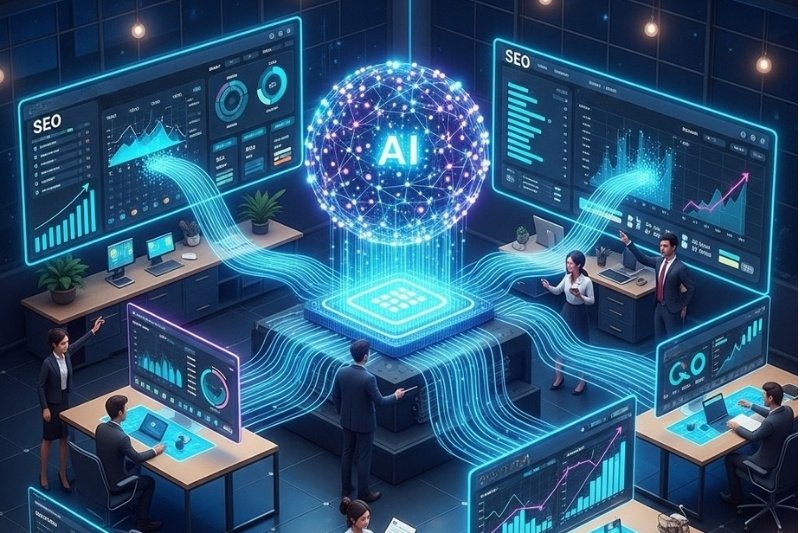
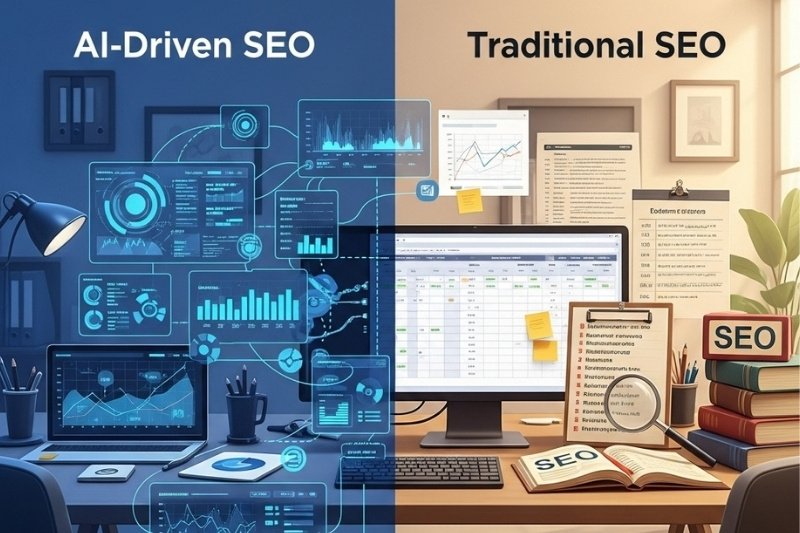
- Traditional SEO builds trust, structure, and long-term visibility
- AI SEO improves speed, efficiency, and data-driven insight
- Neither approach works well alone for small businesses
- The strongest results come from AI-supported traditional SEO
AI vs Traditional SEO: Which Works Better for Small Businesses?
Search engine optimisation has always evolved, but the rise of artificial intelligence has created real confusion for small business owners across the UK. You may be wondering: Is traditional SEO outdated? Can AI tools replace SEO agencies? Which approach actually delivers results for a small business with a limited budget?
This guide breaks down AI SEO vs traditional SEO in clear, practical terms. You’ll learn how each approach works, where each excels, and, most importantly, what combination makes the most sense for small UK businesses in 2026.
Understanding Traditional SEO (In Simple Terms)
Traditional SEO refers to the core optimisation practices that have driven search visibility for years. These methods focus on helping search engines understand what your website is about and why it deserves to rank.
At its foundation, traditional SEO includes:
- Keyword research based on user searches
- On-page optimisation (titles, headings, content structure)
- Technical SEO (site speed, mobile usability, indexing)
- Link building and authority signals
While search engines now use AI extensively, these fundamentals still matter, especially for small businesses building visibility from scratch. Traditional SEO is typically slower, but it’s predictable. When executed correctly, it creates long-term, compounding results that don’t disappear overnight.
What Is AI SEO and How Is It Different?
AI SEO uses artificial intelligence and machine learning to automate, accelerate, and enhance SEO tasks. Instead of manually analysing spreadsheets and search results, AI systems process large datasets and identify patterns in seconds.
AI-driven SEO typically supports:
- Faster keyword and topic discovery
- Content optimisation suggestions based on SERP patterns
- Predictive trend analysis
- Automated technical audits
- Search intent modelling
AI SEO doesn’t replace search engines; it mirrors how modern algorithms already function. Today’s search engines interpret meaning, context, and user behaviour rather than relying purely on exact keywords. For small businesses, AI SEO is appealing because it promises speed and efficiency, but speed alone doesn’t guarantee sustainable growth.
Key Differences Between AI SEO and Traditional SEO
1. Strategy vs Automation
Traditional SEO is strategy-led. It starts with understanding your business, your audience, and your commercial goals, then builds optimisation around that insight. AI SEO, by contrast, is automation-led. It excels at analysing data and identifying opportunities, but it lacks business context unless guided by human expertise.
For small businesses, the real value appears when automation supports strategy rather than replacing it.
2. Cost and Budget Control
Traditional SEO usually involves steady investment over time through manual audits, optimisation, and reporting. AI SEO tools often appear cheaper upfront, offering subscriptions that promise quick wins.
In reality, many small businesses invest in multiple tools without seeing results because they lack strategic direction. For UK SMEs, the highest cost is rarely the tools themselves; it’s misdirected effort.
3. Speed of Execution
AI SEO clearly wins on speed. Tasks that once took days, such as competitor analysis or content restructuring, can now be completed in hours.
Traditional SEO moves more slowly but deliberately. This slower pace often leads to more stable rankings, particularly in competitive service-based industries where trust matters.
4. Content Quality and Trust
AI can assist with content drafting, but trust is built through real experience, market understanding, local relevance, and clear explanations. Search engines increasingly reward content that genuinely helps users.
Businesses that rely solely on mass-produced AI content often struggle with engagement, conversions, and long-term visibility.
Does Traditional SEO Still Work for Small Businesses?
Yes, and it’s still essential.
Traditional SEO provides the structural foundation that AI cannot replace. Without proper technical setup, internal linking, and content hierarchy, AI tools have little to work with.
For small businesses, traditional SEO helps:
- Establish credibility
- Build domain authority
- Rank for local and service-based queries
- Create a predictable lead flow
AI-enhanced search still depends on clean websites, logical content structures, and trust signals.
Where AI SEO Delivers the Most Value
AI SEO shines when used as an enhancement layer, not a standalone solution. For small businesses, AI is particularly useful for:
- Discovering content gaps within existing silos
- Optimising older blog posts for modern search intent
- Analysing competitor strategies at scale
- Improving internal linking suggestions
- Monitoring ranking volatility and trends
This makes AI ideal for scaling SEO efforts efficiently, especially when resources are limited.
Which Approach Is Better for UK Small Businesses?
The honest answer is that neither approach works well in isolation.
Traditional SEO on its own can be slow, labour-intensive, and less responsive to rapid search changes. AI SEO alone can feel generic, lack strategic direction, and become risky when over-automated.
The most successful UK small businesses use a hybrid SEO model: traditional SEO for structure, trust, and long-term growth, supported by AI SEO for speed, efficiency, and insight. This mirrors how modern search engines actually evaluate websites.
SEO for Laymen: A Simple Analogy
Think of SEO like building a shop on a busy high street.
- Traditional SEO is the location, signage, layout, and reputation of your shop.
- AI SEO is using smart analytics to understand foot traffic, customer behaviour, and demand patterns.
Without a solid shop, analytics are useless. Without analytics, growth is slower. Together, they create a competitive advantage.
How This Impacts Local and Service-Based Businesses
Small UK businesses, such as plumbers, consultants, agencies, and retailers, depend heavily on local and service-intent searches.
AI-driven search increasingly prioritises clear service explanations, transparent pricing, helpful FAQs, and strong internal linking. Traditional SEO ensures your site is visible, while AI optimisation helps ensure it is selected and trusted.
Measuring Results: AI SEO vs Traditional SEO
Traditional SEO measurement focuses on rankings, organic traffic growth, and backlinks. AI-enhanced analysis adds deeper insight, including intent alignment, engagement quality, conversion pathways, and visibility within AI-generated summaries.
Despite more advanced metrics, the ultimate measure remains unchanged: leads and revenue.
Common Mistakes Small Businesses Make
Many UK SMEs undermine their SEO efforts by:
- Relying only on AI tools without a strategy
- Publishing AI content at scale without quality checks
- Ignoring technical SEO fundamentals
- Expecting instant results from SEO
Avoiding these mistakes often delivers greater impact than adopting the latest toolset.
The Future of SEO for Small Businesses
SEO in 2026 rewards clarity, usefulness, and consistency. Search engines use AI to identify businesses that genuinely help users, not those chasing shortcuts.
Small businesses that invest in structured content silos, clear service pages, educational content, and AI-supported optimisation will remain competitive, even against larger brands.
Final Verdict: AI vs Traditional SEO
AI SEO is not better than traditional SEO, and traditional SEO is no longer enough on its own.
For small UK businesses, the winning strategy is AI-supported traditional SEO, where human expertise guides AI-driven efficiency. This approach controls costs, reduces risk, improves long-term visibility, and aligns with how modern search engines actually work.
In This Article
Free SEO Audit & Strategy
If you’re unsure whether your current SEO approach is future-ready, or if AI can help you grow faster without risking visibility, we can help.
Ready to Choose the Right SEO Strategy?
Book a Free 30-Minute SEO Consultation