- In 2026, top agencies focus on building data-driven marketing systems, not disconnected campaigns, to create consistent and scalable growth.
- AI and predictive analytics help agencies identify high-intent users, forecast conversions, and optimise budgets for better ROI.
- Automation and data integration allow faster decisions, real-time optimisation, and unified insights across SEO, ads, content, and CRM.
- AI-powered personalisation improves the customer experience and conversions by delivering relevant content, offers, and messaging at every stage.
- The most effective strategies combine AI efficiency with human creativity, ethical data use, and a fully connected digital marketing ecosystem.
AI Data-Driven Marketing in 2026: What Agencies Do Differently (And Why It Works)
Introduction: The New Standard Isn’t “Better Marketing”, It’s Smarter Systems
Digital marketing in 2026 has reached a point where intuition alone isn’t enough. The brands that consistently win aren’t just posting more content or increasing ad spend; they’re building measurable, repeatable systems that turn data into decisions and decisions into revenue. That shift is changing what “good marketing” looks like, especially for businesses that want predictable growth instead of occasional wins.
At the same time, the customer journey has become more complex. People might discover you through social media, compare you via search, read reviews, click an ad, visit your website, leave, come back through remarketing, and convert after a follow-up email. Agencies that manage these touchpoints as disconnected tasks struggle. Agencies that unify them into a single system outperform because they can see what’s happening and optimise fast.
In this blog, we’ll break down what leading agencies do differently in 2026, how they combine AI, automation, and data to build marketing systems that learn and improve over time. As a results-focused digital marketing agency in the UK, helps brands turn their SEO, Google Ads, content, web design, and social media into one connected growth engine, so performance isn’t guessed, it’s engineered.
The Big Shift: From Marketing Campaigns to Marketing Systems
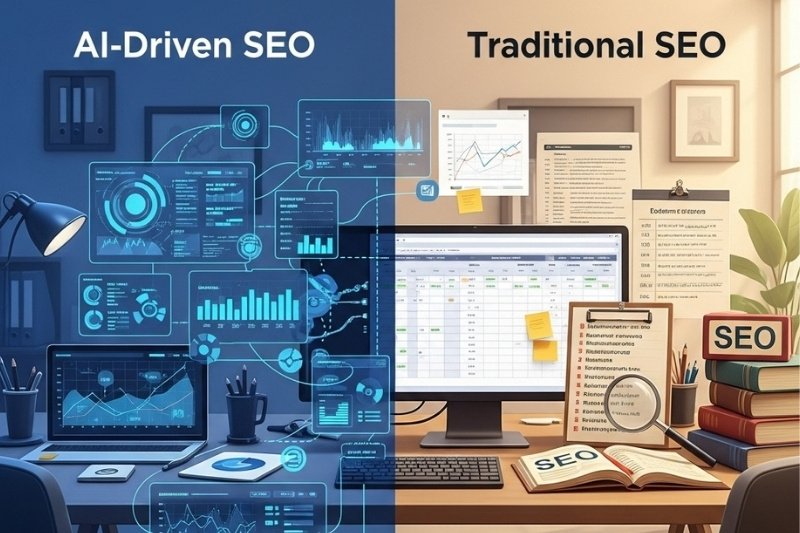
The biggest difference between average agencies and high-performing agencies in 2026 is mindset. Traditional marketing often runs like a sequence of disconnected campaigns: launch a promo, run ads, post on social media, review results, repeat. Modern agencies build always-on systems that continually collect data, learn from it, and improve outcomes week after week.
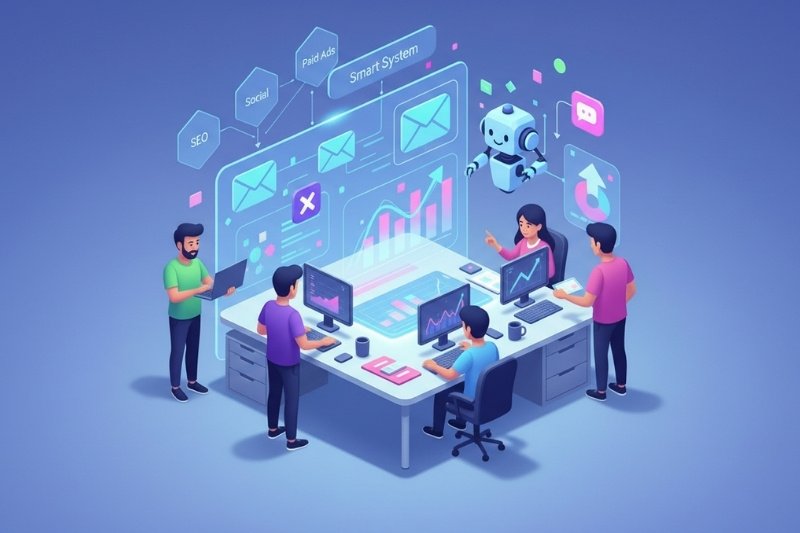
Instead of relying on periodic reporting, the best agencies connect every part of the journey so actions in one channel improve decisions in another. That’s how marketing becomes scalable.
What a “marketing system” usually connects:
- Website analytics: informs targeting and landing page structure
- CRM data: triggers personalised follow-ups and segmentation
- Ad performance: guides creative direction and offers strategy
- Social engagement: influences content themes and messaging angles
This approach reduces wasted effort because every activity feeds the system, and the system keeps getting smarter.
Predictive Analytics: Seeing Tomorrow’s Leads Today
In 2026, agencies don’t just measure what happened, they forecast what’s likely to happen next. Predictive analytics uses data patterns to estimate which users are most likely to convert, when they’re likely to convert, and what message will move them forward.
This matters because budgets are tighter and competition is higher. If you can predict intent more accurately, you can stop spending money on low-probability clicks and focus on the users most likely to buy.
Predictive analytics helps agencies:
- Identify “hot leads” based on behaviour (time on page, repeat visits, product views)
- Estimate conversion probability for different segments
- Forecast seasonal demand and plan campaigns earlier
- Reduce cost-per-acquisition by prioritising high-intent traffic
A practical example: if your data shows users who view a pricing page twice within 48 hours usually convert within 7 days, an agency can automatically trigger remarketing and email nudges during that window, before the lead cools.
Automation: The Invisible Workforce Behind High-Performing Agencies
Automation in 2026 isn’t about replacing humans; it’s about removing repetitive tasks so strategists can focus on creative and growth decisions. Top agencies automate the operational load that often slows marketing down.
When the repetitive work is automated, you get speed, consistency, and fewer errors. And because the system runs continuously, optimisation doesn’t pause when your team is offline.
Tasks modern agencies commonly automate:
- Lead routing and CRM updates
- Email flows based on actions (downloads, visits, abandoned forms)
- Reporting dashboards and KPI summaries
- A/B testing schedules for ads and landing pages
- Social media publishing and performance tagging
This is also where tool integrations matter. High-performing agencies connect platforms so data travels instantly, so decisions happen faster than competitors.
AI-Generated Content: Smarter, Not Just Faster
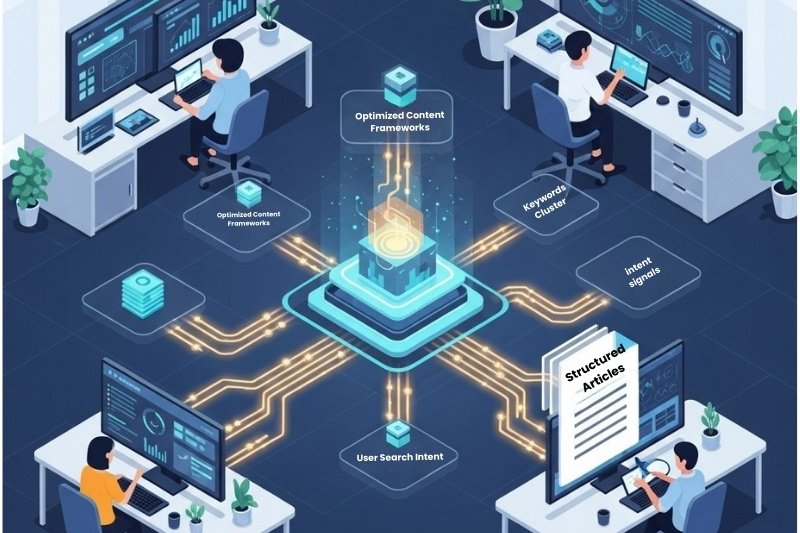
AI content in 2026 is most effective when it’s used for intelligence and iteration, not when it’s used to publish generic content at scale. Smart agencies use AI to analyse what content should be created, how it should be structured, and what variations perform best, then humans add brand voice, context, and credibility.
AI can accelerate creative output, but the winning approach is AI-assisted + human-polished, especially for SEO and paid ads, where trust and clarity decide conversions.
How agencies use AI responsibly for content:
- Discovering high-performing topic clusters for SEO
- Drafting outlines and multiple headline options
- Generating ad copy variations for testing
- Refining tone to match different audiences
- Identifying gaps where competitors are weak
Where humans still make a difference:
- Storytelling that feels authentic
- Brand positioning and emotional tone
- Industry nuance and real expertise
- Compliance, accuracy, and trust-building details
For services like content writing, SEO blogs, and conversion landing pages, that balance is what keeps content both scalable and credible.
Data Integration: Creating a Single Source of Truth
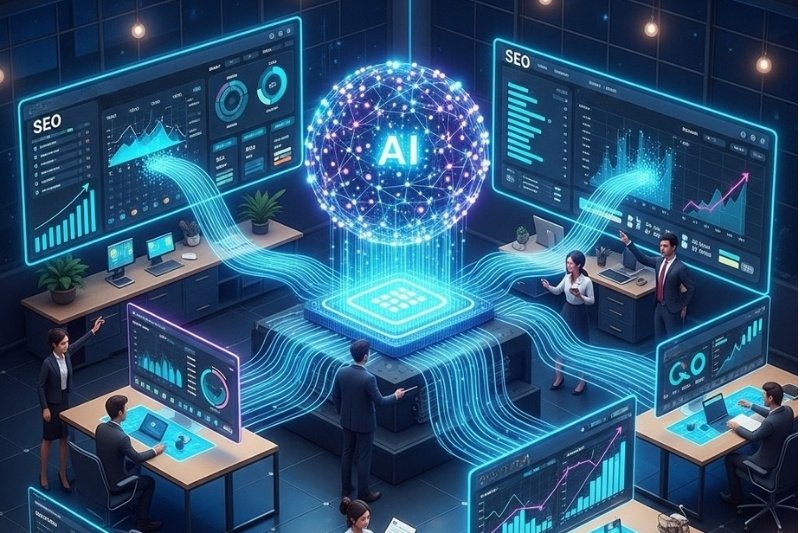
One of the most common reasons marketing underperforms is data living in silos—Google Ads in one place, SEO data in another, CRM in another, and “insights” trapped in spreadsheets. In 2026, agencies solve this by integrating data into unified dashboards so decisions are fast and consistent.
When everything is visible in one system, you stop guessing. You can see what’s working, what’s leaking, and where to optimise next, without waiting for manual reports.
A unified marketing dashboard typically shows:
- Real-time spend, clicks, leads, and revenue
- Funnel drop-off points (where users abandon)
- Performance by channel and campaign type
- Customer lifetime value by segment
- Attribution patterns (what influenced conversions)
This is often where businesses benefit from working with the best digital marketing agency in the UK, because integration requires both technical setup and strategic interpretation, not just tools.
Personalisation at Scale: Beyond “Hi, First Name”
Personalisation in 2026 is no longer limited to adding someone’s name to an email. AI-driven personalisation adapts content, offers, and experiences based on behaviour, so each user sees what’s most relevant to them.
This is powerful because relevance increases trust and reduces friction. Users feel understood, not marketed to.
Personalisation can appear as:
- Dynamic landing page sections (different benefits shown to different users)
- Offers adjusted based on journey stage (first-time vs returning visitor)
- Product or service recommendations based on browsing behaviour
- Email flows triggered by intent signals (pricing views, demo clicks)
For agencies, the advantage is clear: personalisation increases conversions without needing proportional increases in ad spend.
Real-Time Optimisation: Campaigns That Learn Automatically
The strongest agencies in 2026 don’t optimise weekly; they optimise continuously. AI monitors performance minute-by-minute and reallocates budget, shifts targeting, and prioritises creatives that perform better.
That’s how campaigns become “self-improving.” Instead of waiting for human review cycles, the system responds instantly while the data is still fresh.
Real-time optimisation often includes:
- Budget shifts toward higher-converting ad sets
- Automatic pausing of underperforming creatives
- Faster A/B test conclusions based on performance thresholds
- Dynamic bid adjustments tied to conversion probability
This is especially impactful for Google Ads and paid social, where delays in optimisation can waste large chunks of budget in just a few hours.
Voice and Visual Search: The Next SEO Frontier
Search behaviour is changing fast. In 2026, more users search with voice and images, not just typed keywords, especially in local and product discovery journeys. Agencies that adapt their SEO strategy now gain an early advantage.
Voice search tends to be conversational and intent-rich. Visual search relies on metadata, image structure, and context. Agencies that understand both formats design SEO strategies that go beyond traditional text.
How agencies adapt SEO for voice and visual:
- Writing conversational, question-based phrases
- Improving local SEO pages with natural language
- Optimising image alt text and product metadata
- Structuring content for featured snippets and quick answers
- Strengthening technical SEO so pages load instantly on mobile
This is where SEO, web design, and content strategy work best as one system—because modern search is multi-format, not just keyword-based.
Ethical AI: Trust Is a Growth Strategy
As AI becomes more embedded in marketing decisions, ethical use becomes a competitive advantage. People care how their data is used, and regulators are stricter than ever. Agencies that treat transparency as optional create risk for clients; agencies that treat it as policy build long-term trust.
Ethical AI practices agencies focus on:
- Clear disclosure of AI-assisted tasks
- Responsible data handling and anonymisation
- Avoiding manipulative personalisation tactics
- Protecting sensitive customer information
- Maintaining accuracy, especially in regulated industries
Trust isn’t just a “brand value”, it directly affects conversion rates, retention, and reputation.
Cross-Platform Integration: Where Marketing Meets Operations
In 2026, the strongest agencies don’t stop at marketing platforms. They integrate marketing with business operations, inventory systems, scheduling tools, CRMs, and customer service, so campaigns reflect what’s happening in real time. This turns marketing from a separate department into a live extension of the business.
Examples of cross-platform automation:
- Pausing ads automatically when stock is low
- Increasing promotions when capacity opens (appointments, bookings)
- Triggering remarketing when users contact support
- Adjusting offers based on location, time, or demand signals
This is one of the biggest “agency differences” in 2026: they don’t just run ads, they build connected systems that protect budget and improve customer experience.
Human Creativity Still Wins: The Differentiator AI Can’t Copy
Even with automation and AI, the agencies that win are the ones that understand people. AI can analyse patterns, but humans understand emotion, culture, humour, storytelling, and brand meaning. The best agencies use AI to handle data and repetition, and humans to deliver identity and resonance.
This is especially important in:
- Brand positioning and messaging
- Scroll-stopping creative direction
- Story-driven campaigns
- Community building on social media
- High-trust content like case studies and service pages
AI can accelerate output, but human creativity ensures the output actually connects.
Final Thoughts: What Businesses Should Take Away in 2026
The agencies performing best in 2026 are building self-learning marketing systems, not isolated campaigns. They connect channels, integrate data, personalise experiences, automate repetitive tasks, and optimise continuously, so every week becomes smarter than the last.
If you want to compete in this landscape, the real question isn’t “Should we use AI?” It’s “How quickly can we build a system that uses AI responsibly and profitably?” Because the brands that move first gain efficiency, insights, and momentum that late adopters struggle to match.
Working with an AI-Driven Digital Marketing Agency in the UK helps you implement this approach the right way, combining SEO, Google Ads, web design, content writing, graphic design, and social media marketing into one connected growth engine that’s built for 2026 and beyond.
In This Article
Free Data-Driven Marketing Audit
Not sure if your marketing works as a system or isolated efforts? Our free audit reviews your data, automation, and channel integration to uncover leaks, missed insights, and growth opportunities.
Ready to Build a Smarter Marketing System?
Book a free 30-minute consultation to see how AI, automation, and data can unify your SEO, ads, content, and website into a predictable growth engine.