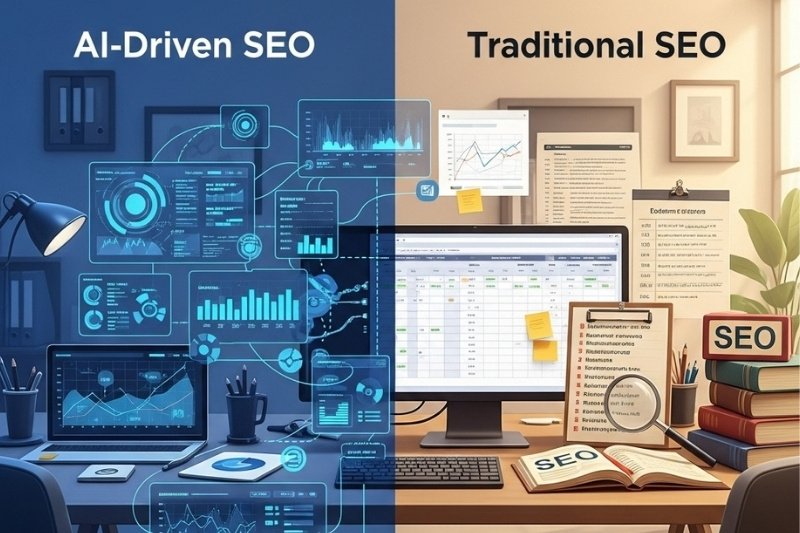

AI in SEO: The Future of Search Engine Optimization in 2026
Search engine optimisation is no longer just about keywords, backlinks, and technical checklists. By 2026, AI has fundamentally reshaped how search engines understand content, rank websites, and answer user questions. For UK businesses, this shift creates both opportunity and uncertainty. Business owners are asking practical questions: Will AI replace SEO? Will Google penalise AI content? Is SEO still worth investing in?
This guide explains AI in SEO in plain, business-friendly language without losing technical depth. Whether you run a small local company or manage a growing UK brand, you’ll understand what’s changing, why it matters, and how to stay visible in AI-driven search.
What Does “AI in SEO” Actually Mean?
Artificial intelligence in SEO refers to how machine learning systems interpret, evaluate, and rank content. Instead of relying heavily on rigid rules, search engines now analyse:
- Search intent and context
- User behaviour and engagement signals
- Content usefulness, clarity, and credibility
- Topical authority across your entire website
Modern search engines no longer match pages to keywords. They predict what users want to know next and surface the most helpful sources.
At the centre of this shift is Google. Its ranking systems use AI models to understand meaning, relationships between topics, and real-world expertise, especially for queries involving money, health, or business decisions.
For business owners, this means SEO is less about gaming algorithms and more about demonstrating genuine expertise and trust.
How AI Is Changing Search Results in 2026
1. From Blue Links to AI Overviews
Search results are no longer just a list of websites. AI-generated summaries, often called AI Overviews, answer questions directly at the top of the page. These summaries pull insights from multiple trusted sources.
If your content is clear, authoritative, and well-structured, it can still be featured or cited within these AI answers, even if users don’t click immediately.
2. Context Over Keywords
AI understands that “SEO cost in the UK” and “how much should a business spend on SEO” are essentially the same question. This reduces reliance on exact-match keywords and increases the importance of topic coverage.
3. User Satisfaction Signals Matter More
AI systems learn from how users interact with search results. Pages that genuinely help users by answering questions clearly and logically send strong quality signals.
Will AI Replace SEO Agencies?
This is one of the most common concerns among UK business owners. The short answer: No, but SEO agencies that don’t adapt will struggle.
AI automates repetitive tasks like:
- Basic keyword research
- Content outlines
- Technical audits
However, AI cannot replace:
- Strategic decision-making
- Market and competitor insight
- Brand positioning
- Conversion optimisation
- Ethical and compliant SEO practices
In 2026, the best agencies use AI as a tool, not a replacement. Human expertise is still essential to interpret data, align SEO with business goals, and build trust signals that AI alone cannot fabricate.
Is AI-Generated Content Safe for SEO?
Another major worry is whether AI-written content will be penalised. Google’s stance is clear: content is judged by quality, not by how it’s created.
AI content becomes risky when it:
- Repeats existing information without insight
- Lacks originality or real expertise
- Is published at scale without editorial review
High-performing content in 2026 typically follows a human-led, AI-assisted approach. AI helps with research and structure, while human experts refine tone, accuracy, and relevance, especially for UK audiences and regulations.
Why Topical Authority Is the New SEO Foundation
AI-driven search engines evaluate entire websites, not just individual pages. This is where topical authority comes in.
Topical authority means:
- Covering a subject comprehensively
- Answering beginner and advanced questions
- Interlinking related content logically
- Demonstrating real-world experience
For example, a strong AI SEO silo might include:
- What AI SEO is
- How AI affects rankings
- Costs and ROI of SEO
- Local SEO implications in the UK
- Technical SEO foundations
This structure helps search engines and AI systems understand what your business is truly an expert in.
Technical SEO Still Matters (But for Different Reasons)
Some business owners assume AI makes technical SEO irrelevant. The opposite is true. AI systems depend on clean, accessible websites to understand content properly. Key technical areas include:
- Core Web Vitals (speed, stability, responsiveness)
- Mobile usability
- Crawlability and indexation
- Structured internal linking
- Secure, reliable hosting
A technically weak site limits how well AI can interpret and trust your content, regardless of how good the writing is.
How AI Impacts Local SEO in the UK
Local search is becoming increasingly conversational. Users ask questions like:
- “Who’s the best SEO agency near me?”
- “Is SEO worth it for small UK businesses?”
AI evaluates:
- Location relevance
- Service clarity
- Reviews and reputation
- Localised content depth
UK businesses that combine local SEO fundamentals with AI-aware content strategies gain a strong advantage, especially in competitive regions.
Measuring SEO Success in an AI-Driven World
Traditional metrics like rankings still matter, but they’re no longer enough. In 2026, successful SEO measurement includes:
- Visibility in AI Overviews
- Growth in branded searches
- Engagement and dwell time
- Conversion paths from organic traffic
- Lead quality, not just volume
AI prioritises outcomes over tactics, aligning SEO more closely with real business performance.
Common AI SEO Myths (That Hold Businesses Back)
Let’s clear up a few misconceptions:
- “SEO is dead.”
SEO is evolving, not disappearing. - “AI content automatically ranks.”
Without strategy and quality control, it usually doesn’t. - “Only big brands can win.”
Smaller UK businesses can outperform larger competitors through niche authority and clarity.
Understanding these realities helps business owners invest confidently instead of reacting to fear-driven headlines.
How Businesses Should Prepare for SEO in 2026
The most future-proof SEO strategies focus on fundamentals enhanced by AI:
- Clear value propositions
- Educational, problem-solving content
- Strong internal linking between related topics
- Consistent publishing within defined silos
- Ethical optimisation aligned with Google guidelines
This approach benefits both human readers and AI systems, ensuring long-term visibility.
Final Thoughts: AI Is Reshaping SEO, Not Replacing It
AI has changed how search works, but not why people search. Users still want reliable answers, trustworthy businesses, and clear guidance, especially when making commercial decisions.
SEO in 2026 rewards brands that:
- Educate instead of manipulate
- Build authority instead of chasing loopholes
- Think strategically instead of tactically
For UK businesses, adapting early means staying visible, credible, and competitive as AI continues to evolve.
In This Article
Free SEO Audit & Strategy
If you’re unsure whether your current SEO approach is future-ready, or if AI can help you grow faster without risking visibility, we can help.
Ready to Choose the Right SEO Strategy?
Book a Free 30-Minute SEO Consultation